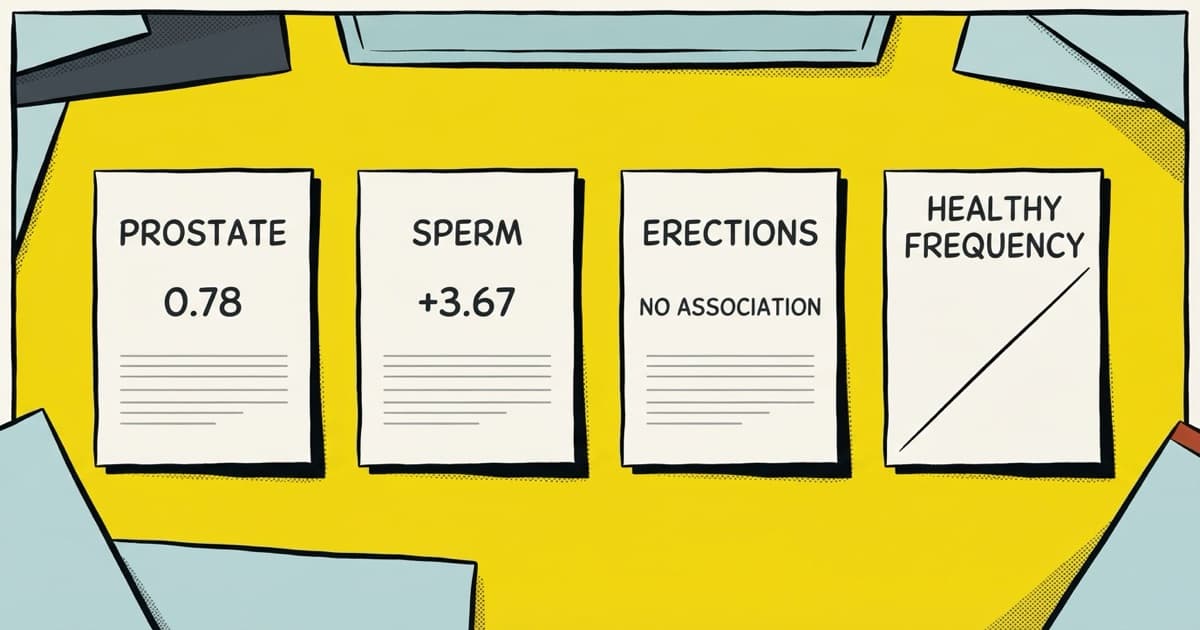
Start with what is missing here, because it will save you reading ten pages: no study sets a healthy frequency. No medical classification contains a number. If you see "two or three times a week is normal" somewhere, somebody wrote that; nobody measured it.
A few specific things have been measured. Below are all of them we could find, with the numbers and with what those numbers do not show.
Prostate
The largest study in this area followed 31,925 men across 480,831 person-years, in which 3,839 prostate cancers occurred. It compared men reporting 21 or more ejaculations a month with men reporting 4 to 7. In the 40–49 age band the risk was lower: HR 0.78, confidence interval 0.69–0.89[1].
Now the caveat the authors give themselves, and which goes missing in summaries: they cannot rule out that the result comes from who gets screened and biopsied more often[1]. Men who report more sexual activity may simply see a doctor more.
So this is a signal, not a prescription. Nobody has shown that increasing the frequency changes anything.
Fertility
Here the result runs against the intuition that you are "saving something up". A meta-analysis of 13 randomised trials and 2,315 participants looked at what a longer gap before giving a sample does. Longer abstinence raised sperm DNA fragmentation: mean difference 3.67, confidence interval 2.32–5.03[2]. Progressive and total motility did not change significantly.
What that analysis did not look at: pregnancies. The trials it pooled did not report them[2], so what it means in practice is still open.
The reproductive medicine guidance says the same thing more simply: fertility is highest with intercourse every one to two days in the fertile window, but "couples should not be advised to limit the frequency of intercourse when trying to achieve pregnancy"[3].
Erections
The claim repeated most often here is that watching pornography damages erections. Three samples tested it together, and the conclusion is nuanced but clear: "there is little or no evidence of an association between mere pornography use and ED, consistent evidence of an association between self-reported problematic use and ED cross-sectionally, and no evidence of causal links"[4].
In other words, the measure is not quantity. The measure is whether somebody considers themselves to have lost control of it.
And if you stop for a month?
That has been tested too. A study of a month of abstinence found no significant change in sexual pleasure, desire, dysfunction or excitation among those who took part[5].
The caveat that makes the number worth anything: 74% of participants dropped out between measurements, and everything was self-reported[5]. That is weak evidence, and weak in both directions. It does not show that a month off does nothing — only that nobody has shown it properly.
So where is the line
If there is no number, there is something else. The only threshold that exists in any classification has nothing to do with frequency. It is about control and distress: a pattern of failure to control intense impulses persisting for six months or more, causing marked distress or impairment of functioning[6].
And one addition that saves people months of unnecessary worry in this particular subject: the same guidelines say that distress arising entirely from moral judgements about one's own impulses is not sufficient for that diagnosis[6].
The short version
- There is no healthy number. Nobody has set one.
- More frequent ejaculation was associated with lower prostate cancer risk, but the authors cannot rule out that this reflects who gets screened.
- A longer gap raised sperm DNA fragmentation. Nobody converted that into pregnancies.
- Mere pornography use was not associated with erectile problems. Feeling out of control of it was.
- A month off changed nothing measurable — in a study that lost three quarters of its participants.
If you came here looking for a reason to change something, the honest answer is that these numbers will not give you one. The reason is usually somewhere else, and that is fine. We wrote about that separately.