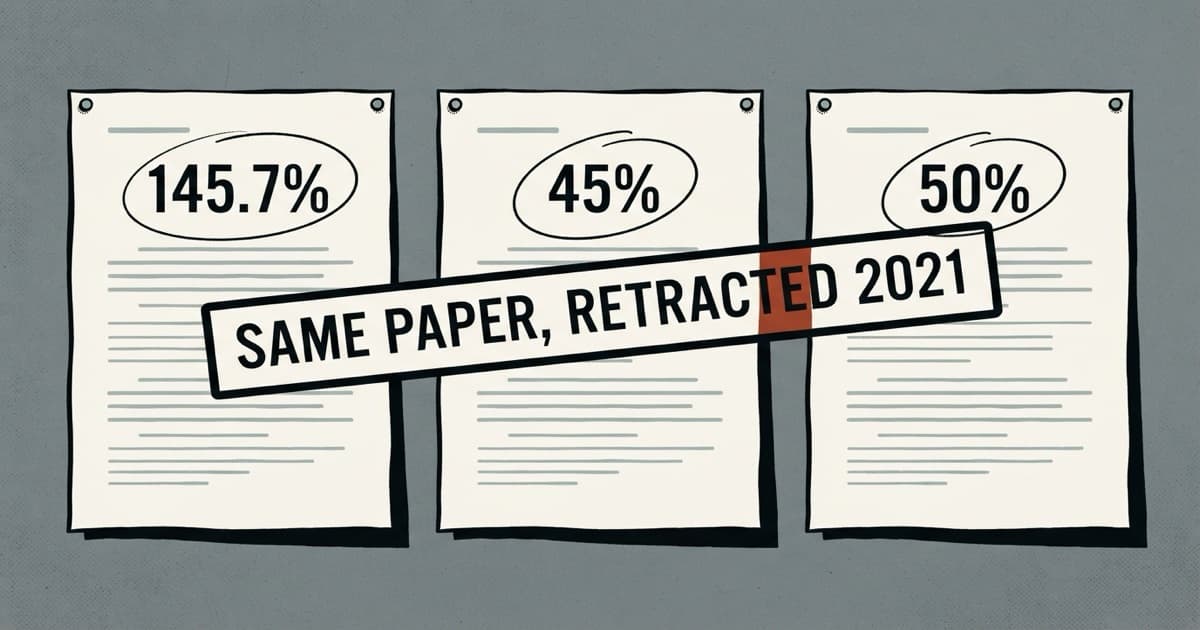
Ask this question in Google and you get a number. Usually one of two: a 45% rise or a 50% rise after seven days without ejaculating.
Both come from the same paper. That paper was retracted by its journal in 2021.
This is not a conspiracy theory or a quibble. On 4 August 2026 we checked what the pages on the first Polish results page actually say — and what stands in their own reference lists.
Where the number comes from
The source is a 2003 study of 28 men. Its abstract says that on the seventh day of abstinence a clear peak of serum testosterone appears, reaching 145.7% of the baseline[1].
145.7% of baseline is a rise of just under 46%. Hence "45%". Hence also "50%", from somebody who rounded. Two different figures circulating online are not two different studies — they are two paraphrases of one sentence.
PubMed flags the paper as a Retracted Publication. It was withdrawn in 2021[1].
What is on the first page of Google
The first result states in its body text that testosterone "rose sharply after 7 days (by as much as 50% relative to the value recorded after ejaculation)"[2].
That same page carries this entry in its bibliography: "Jiang, M., Jiang, X., Zou, Q. et al. RETRACTED ARTICLE: A research on the relationship between ejaculation and serum testosterone level in men"[2].
The word RETRACTED is in the references. In the text somebody will actually read, there is not a word about it.
The sixth result, also cited by Google's own AI Overview, writes: "Earlier research from 2003 showed that abstaining from masturbation for exactly 7 days can raise testosterone concentration by as much as 45%"[3]. In its reference list the same Jiang paper appears with no retraction marker of any kind[3].
We are not accusing anybody of bad faith. The point is narrower: the answer you are given to this question rests on a paper that no longer stands.
So what is actually known
Not much — and that has to be said plainly rather than filled in with a number of our own.
The only randomised study on the question we could find is a 2021 pilot. Eleven young men volunteered, three withdrew, eight were analysed. All were highly advanced strength athletes in committed relationships, recruited on a single campus[4].
The result: a significant between-condition difference in free testosterone, and no change in hormonal ratios. The authors' own conclusion, verbatim: "It can be assumed that masturbation may have a potential effect on free testosterone concentrations but not on hormonal ratios. However, additional studies with larger sample sizes are needed to validate these findings."[4]
Eight people. The authors themselves ask for a replication at scale. That is the honest state of the evidence, and there is no headline in it.
Why this does not go away
Because the publisher's own site still serves the 2003 article in full, abstract and references included, with no retraction notice — while the retraction itself, under its own DOI, returns "no such item found" on that same site[5].
Anyone who checks the source at the publisher rather than in PubMed comes away believing the study stands. We wrote that up separately, with the state of both pages.
The short version
- "+45%" and "+50%" are the same retracted 2003 paper on 28 men.
- The top Google result has the word RETRACTED in its own references and does not mention it in the text.
- The only randomised study is a pilot with eight men analysed, whose authors ask for it to be repeated.
- There is no evidence that masturbation lowers testosterone. There is also no evidence for the seven-day spike. Both are an absence of evidence, not evidence.
If testosterone was going to be your reason, the most honest thing we can do is tell you we have nothing to support it with. The reasons that do hold up are elsewhere.