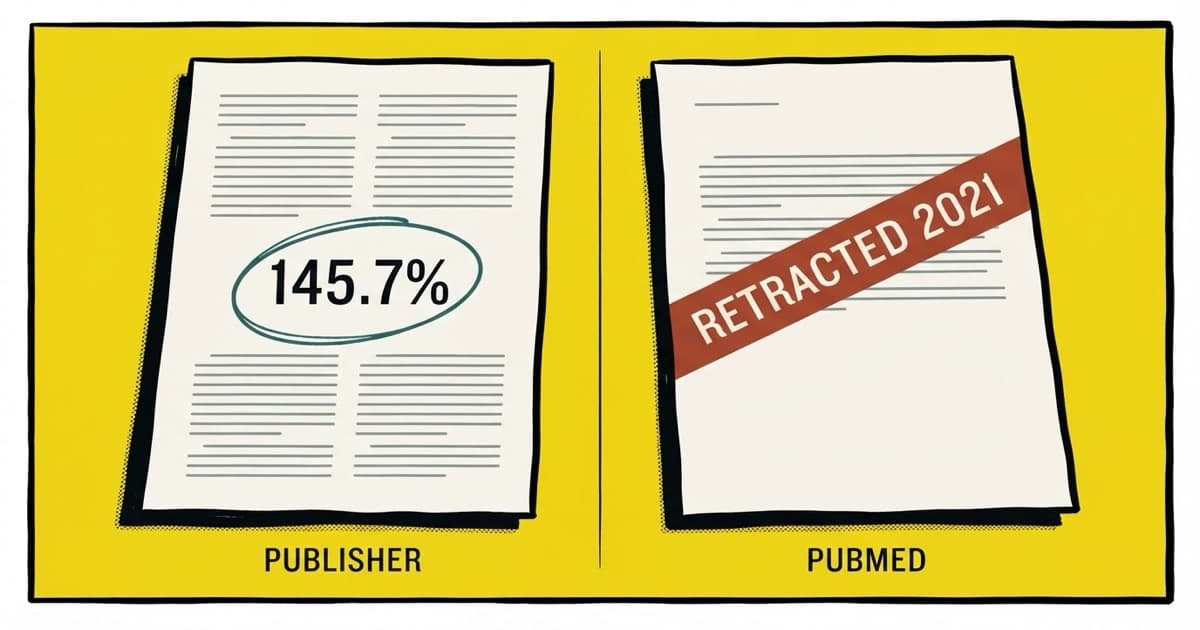
If you have spent even an hour on NoFap forums you know the number: on the seventh day of abstinence testosterone jumps by 145.7%. It turns up in infographics, in YouTube videos, in app store listings. It is precise, it has a decimal place, and it looks exactly like something that came out of a laboratory.
It did. One laboratory, in 2003, with twenty-eight men. The paper is called A research on the relationship between ejaculation and serum testosterone level in men, and it does contain that sentence: on the seventh day of abstinence a clear peak of serum testosterone appeared, reaching 145.7% of the baseline[1].
There is just one problem. The paper was retracted.
What happened
In 2021 the journal withdrew the article. PubMed now labels it a "Retracted Publication" and links to the retraction notice[1]. This is not a correction or an erratum — it voids the publication.
The finding has never been independently replicated. There is no second study showing that peak. For twenty years the whole edifice rested on a single sample of twenty-eight men, and then it did not even rest on that.
Why the claim survives
Here it gets interesting.
On 2 August 2026 we opened the publisher's page — the one the article's official DOI resolves to. The article is there: full abstract, reference list, comment section. Nowhere on that page is there a word about the retraction[2].
More than that, the DOI of the retraction notice itself does not work on that site. It returns a message saying no item with that identifier exists.
What follows from this
Not that abstinence is pointless. That one particular argument for it collapses — and it is the one usually offered first.
If somebody sells you a challenge on a testosterone headline, they are selling you a retracted study. That applies to apps too: a review of 23 apps for problematic pornography use found that none of them referenced literature providing direct evidence of its own efficacy or safety[3]. Ours cannot either, because no such evidence exists.
The reasons to cut back on compulsive pornography use are entirely different and have nothing to do with hormones. They usually sound like "this takes two hours of my day" or "I do this instead of talking to anyone". Those reasons do not need a study. It is enough that they are true.