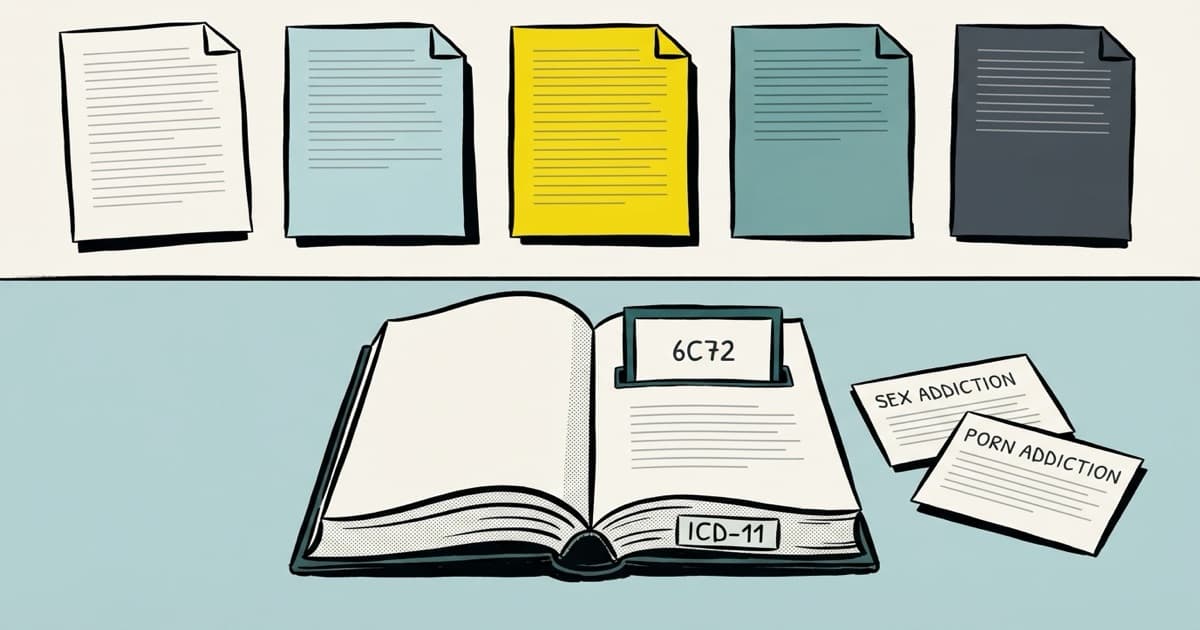
Three names circulate interchangeably: sex addiction, pornography addiction, CSBD. Only one of them is in the international classification of diseases, and the difference matters at a very practical moment — when you are trying to describe to a clinician why you came.
What is a diagnosis
Compulsive sexual behaviour disorder, ICD-11 code 6C72[2]. The guidelines describe a persistent pattern of failure to control intense, repetitive sexual impulses or urges resulting in repetitive sexual behaviour over an extended period, six months or more, causing marked distress or impairment in personal, family, social, educational or occupational functioning[1].
Two things in that definition matter more than they look.
First, there is no frequency in it. No threshold of times per week. The criterion is about control and cost, not about a count.
Second, the guidelines say plainly that distress entirely related to moral judgements and disapproval about one's own sexual impulses, urges or behaviours is not sufficient to meet the requirement[1].
What is not a diagnosis
"Pornography addiction" is not a separate entity in ICD-11 or in DSM-5. You can use pornography in a way that meets the CSBD criteria — but pornography has no diagnosis of its own.
"Sex addiction" is a colloquial term. It appears in neither of the two classifications in force. That does not make the experience it describes invented; it means that is not what it is called in a consulting room.
How many people this affects
Care is needed here, because numbers travel the internet with no provenance.
A 2025 community study reported 10.8% probable CSBD in a sample of 296 people (12.3% among men). That sounds high — and the authors think so too. They write that their rate is higher than typical previous estimates, which usually fall between 3% and 6%, and that the study was not designed to be epidemiologically representative[4]. Recruitment ran through a paid survey platform and the instrument was a self-report measure, not a clinical interview.
We give no figure for Poland. The work by the Polish team that studied it sits behind a paywall and could not be checked in full text — and on this site that is the condition for printing a number.
Why the distinction is worth having
Because it decides what you go looking for. If the problem is a loss of control that has held for half a year with a real cost — work, a relationship, sleep — then it has a name, a code and specialists who work on it. If the problem is guilt over doing something you believe you should not do, that is real suffering too, but it is resolved differently, and a day counter is more likely to deepen it than to reduce it.