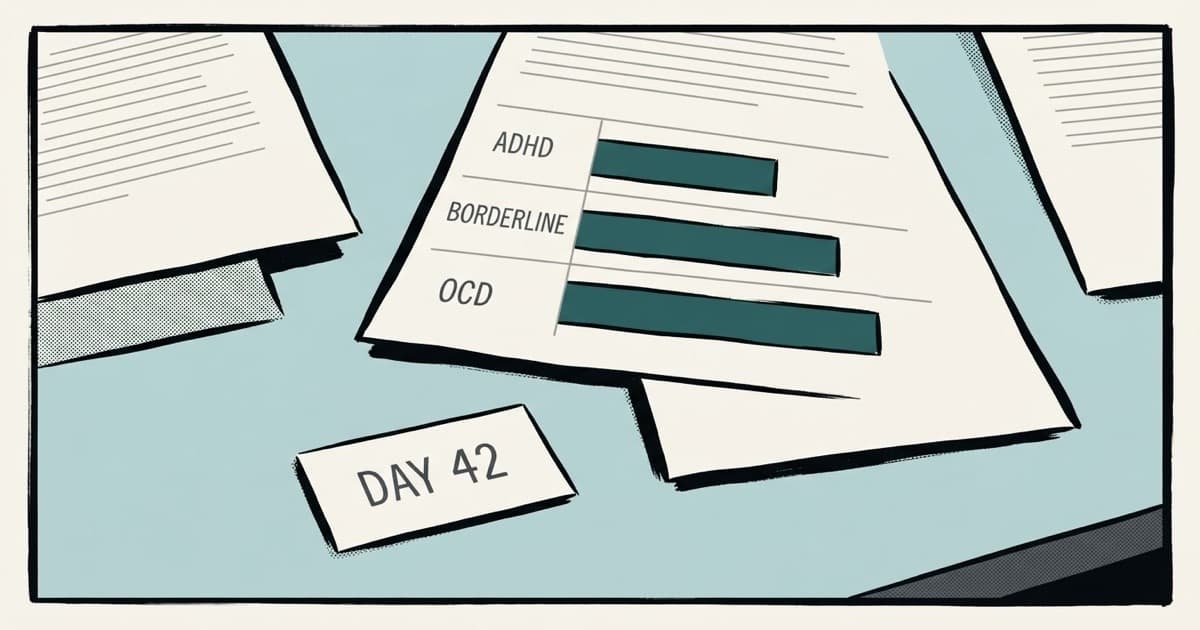
The most common story in this neighbourhood goes like this: somebody counts days for six months, the streak rises and resets, and underneath nothing moves. Because underneath there is something else.
What the study found
A 2025 community sample compared people with probable CSBD against the rest of the participants. The CSBD group scored significantly higher on[1]:
- ADHD symptoms (p < 0.001)
- borderline personality traits (p < 0.001)
- obsessive-compulsive symptoms (p < 0.001)
- social media addiction (p < 0.001)
- drug use problems (p < 0.001)
- general compulsivity (p = 0.018) and impulsivity (p = 0.005)
Why this is practical rather than trivia
Because it changes the order of operations.
If difficulty stopping is one of several expressions of difficulty stopping in general — which is what a profile with ADHD, impulsivity and compulsivity in the same row looks like — then a tool addressing one behaviour is working on the narrowest possible front.
The day counter is not wrong in that case. It is insufficient, and its lack of effect gets read as evidence that "something is wrong with me", which is exactly the opposite of the warranted conclusion.
What follows for an app
A review of 23 apps for problematic pornography use found three things dominating them: counting days abstinent, goal setting and psychoeducation — and none of them referenced literature providing direct evidence of its own efficacy or safety[3].
Which is why this app includes a short, explicitly non-diagnostic orientation questionnaire built on the openly described ICD-11 criteria[2], whose answers are never stored — they are scored and discarded. A high result does not block the challenge; it shows a screen about where to find help. Blocking would push somebody towards the places where nobody is looking out for them.
When it is worth taking this to somebody
If any of these sound familiar beyond the masturbation itself: chronic postponing of things that cannot be postponed; flashes of temper you cannot explain afterwards; sleep that drifts out of shape every few weeks; the sense that something has to be running in the background before anything can get done. These are not symptoms you can wait out by counting days, and they are not something to be ashamed of — they are a reason for one appointment.