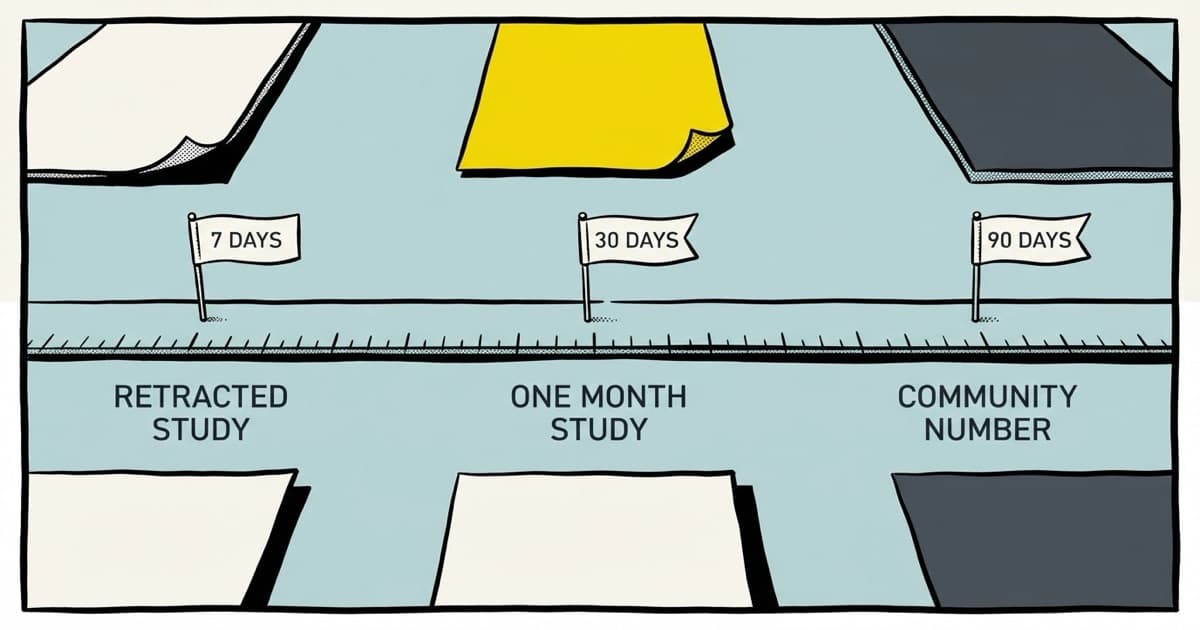
Short answer: no study establishes how many days of abstinence are optimal or safe. Nobody has worked it out, because there is nothing to work out — there is no outcome that gets better as the day count rises.
The long answer is more interesting, because it explains where the numbers you know came from.
Where 7 days comes from
From a single study of 28 men showing a testosterone peak on day seven. That paper was retracted in 2021[3] and has never been replicated. We wrote about it separately, including why the claim outlived the retraction.
Seven days has exactly one justification left, and it is practical: it is the shortest span worth counting at all, and the one people are least likely to abandon.
Where 30 days comes from
From the fact that November has thirty days. Genuinely — "No Nut November" is a meme that became a mass phenomenon and then got studied.
The result is unexpectedly calm: among people who took part in the month-long challenge, there were no significant changes in sexual pleasure, desire, dysfunction or excitation compared with those who did not[1].
For us that is enough to set a month as a sensible recommended maximum: nothing suggests it does harm, and nothing suggests longer is better.
Where 90 days comes from
From the community. Only from the community. No study supports the number, and none shows a benefit from abstaining for longer than a month.
There is one signal pointing the other way. A meta-analysis of 13 randomised trials (2315 participants) found that longer abstinence goes with higher sperm DNA fragmentation: a mean difference of 3.67 percentage points (95% CI 2.32–5.03)[2]. The same meta-analysis did not confirm an effect on sperm motility — the differences were not statistically significant — and could not assess pregnancy at all, because the trials did not report it.
That is why longer challenges in this app come with a warning, and are simply blocked for anyone trying to conceive.
The honest version of the answer
No research shows a benefit from abstaining for longer than a month. There is a signal that it does harm if you are trying to conceive. Longer challenges are at your own risk.
And one thing that matters more than the day count: if a week in, the same thought keeps returning — that the evening cannot be got through without it — then the length of the challenge is not the problem.