This is the one article on this site where the research says something fairly unambiguous, and what it says runs against the intuition most people have.
The intuition goes: hold off for a week, "save up", improve the odds. It comes from a simple model in which sperm is a resource that accumulates. The model is half right — volume and count do rise — except that quality matters too, and quality goes the other way.
What the meta-analysis found
Thirteen randomised trials, 2315 participants in total, comparing shorter with longer ejaculatory abstinence[1]:
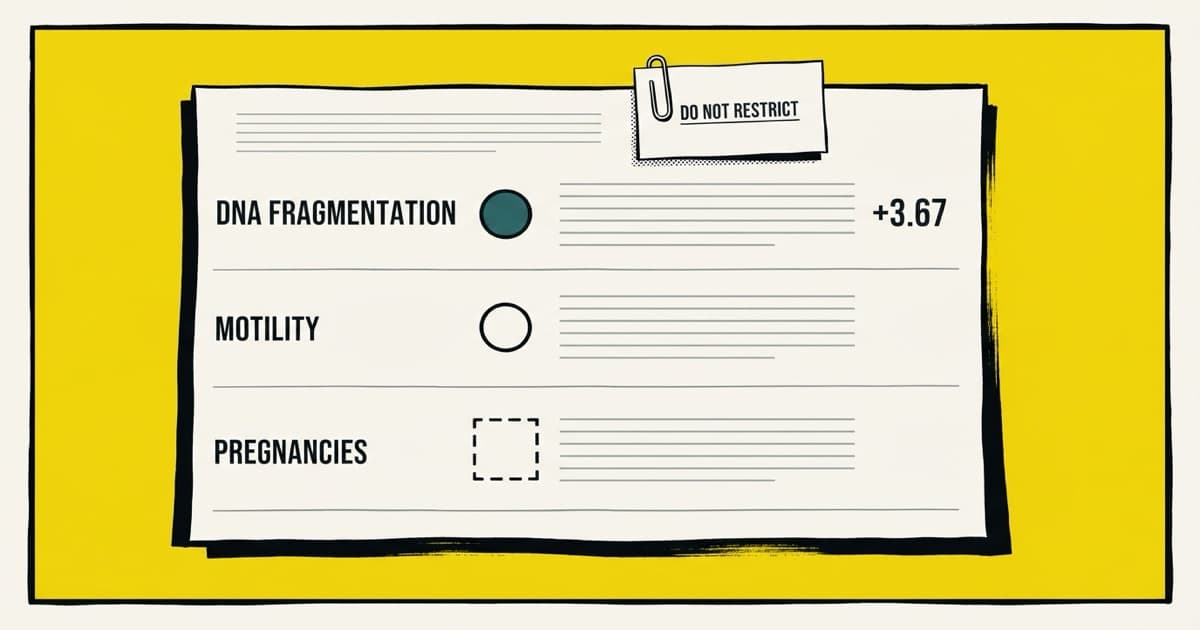
- Sperm DNA fragmentation rises with longer abstinence. Mean difference 3.67 percentage points, 95% CI 2.32–5.03, p < 0.01. It is the only parameter where the effect is clear and significant.
- Motility: no significant effect. Progressive motility − 1.34 at p = 0.1, total motility − 1.15 at p = 0.35. Neither difference is statistically significant.
- Pregnancy and birth: no data. The authors state plainly that they did not assess pregnancy rates, because the included trials did not report them.
What the guidance says
The American Society for Reproductive Medicine's committee opinion on optimising natural fertility puts it in three sentences that are worth reading together rather than separately[2]:
- Reproductive efficiency rises with the frequency of intercourse and is highest with intercourse every 1 to 2 days during the fertile window.
- But cycle fecundity was similar with intercourse daily, every other day, and even every three days in the fertile window.
- And the decisive one: couples should not be advised to limit the frequency of intercourse when trying to conceive.
The first sentence gets quoted alone, and then it reads like an instruction to perform every 1–2 days. Together with the other two it means something different: there is no schedule to keep, and there is advice not to restrict anything.
Separately, it is worth knowing that the WHO manual on semen examination still recommends 2–7 days of abstinence before a test — but that recommendation is pragmatic, about standardising a laboratory sample, not about optimising fertility.
What this means for a challenge
Directly: if you are trying to conceive, long abstinence has no justification, and one line of evidence suggests it may do harm. That is why choosing a challenge longer than a month is blocked in this app for anyone who has said they are trying to conceive — not to lecture anybody, but because it is the one place in the whole product where the research allows a firm statement.
And the message has to be delivered exactly: not "you must, every 1–2 days", but "do not restrict anything".