This article opens with an admission, because otherwise it would be dishonest.
The first version of this product's plan said: "31% lower risk of prostate cancer, Rider 2016". The number looked solid, the study is real and large, everything checked out. Then somebody opened the full text.
The figure 31% is not in that paper.
What the 2016 study actually found
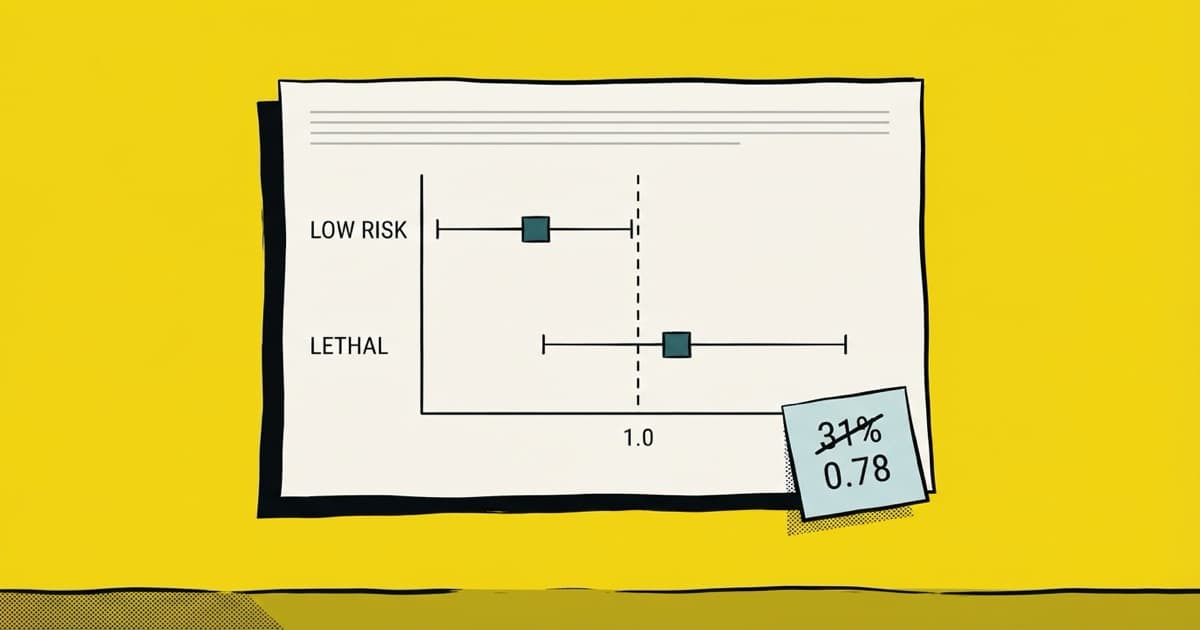
Rider and colleagues followed 31,925 men for nearly two decades: 480,831 person-years of observation, 3839 diagnosed prostate cancers. Comparing 21 or more ejaculations a month with 4–7 gave HR 0.78 (95% CI 0.69–0.89) for frequency at ages 40–49[1].
That is about a 20% lower rate of diagnosis, not 31%.
And that is still not the whole story, because breaking it down by disease type changes what the result means:
| Type of cancer | HR | 95% CI |
|---|---|---|
| Low-risk | 0.72 | 0.61–0.83 |
| Organ-confined | 0.78 | 0.71–0.86 |
| Advanced | 0.85 | 0.67–1.07 |
| Lethal | 0.95 | 0.73–1.24 |
The bottom two rows have confidence intervals crossing one. That means for advanced and lethal disease the result is not statistically significant. The effect sits almost entirely in low-risk cancers.
Where "over 30%" came from
From an earlier analysis of the same cohort. In 2004 Leitzmann and colleagues reported RR 0.67 (0.51–0.89) for 21 or more ejaculations a month, averaged across a lifetime[2] — roughly a third lower. That is the number still circulating today.
The catch is that the 2016 update, with another decade of follow-up, weakened it. When you add data and the effect shrinks, the later version is the more credible one. The internet kept the reverse: the stronger 2004 figure, attached to the newer 2016 study.
What to do with this
Nothing dramatic. It is an observational study, not an experiment, and nobody prescribes a frequency on the strength of it.
But if you are looking here for an argument for or against abstinence, it is not here — at most a weak signal towards "there is no reason to hold off", concerning mainly the cancers that rarely kill anyone anyway.
How we got it wrong is more interesting than the mistake itself: we took a number from a summary rather than from the full text. That is the one error that genuinely repeats in this subject, and it is why every source on this site carries the date somebody opened the full text.