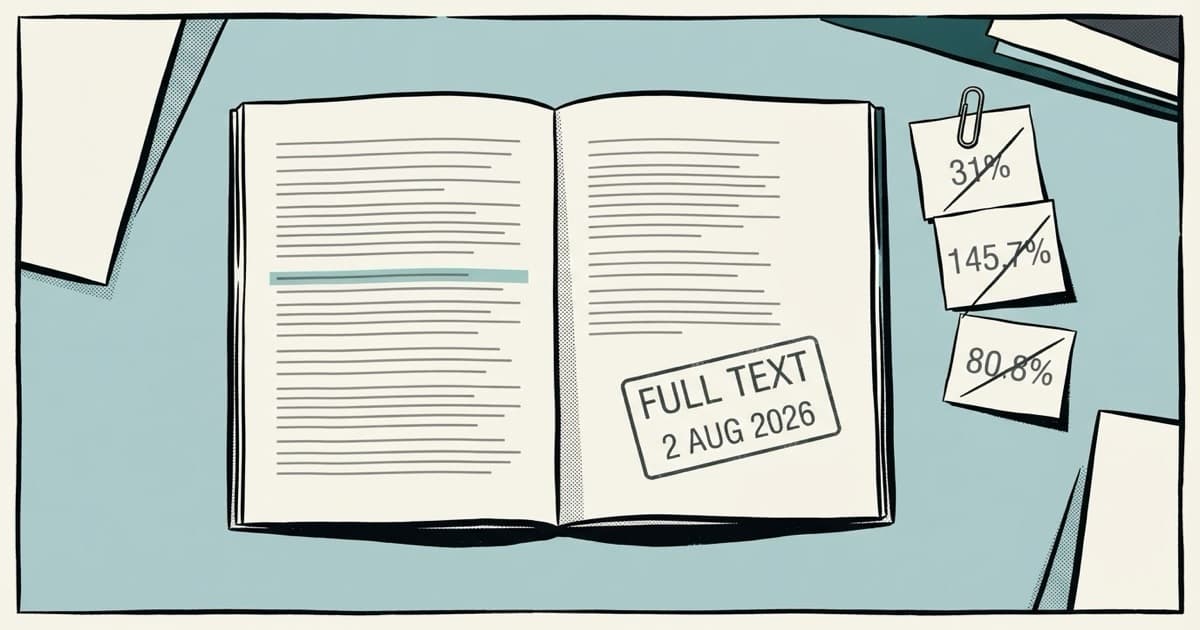
There is one rule, and it sounds trivial until you apply it: every number in these articles has to come from the full text of the study, not from a summary of it.
It stops being trivial at the moment you find out how many claims fail it.
What that looks like in practice
Before a number reaches an article, somebody opens the source and looks for that specific sentence in it. Not a write-up on a science news site, not a paragraph in another article, not a product page. The paper.
Every source at the foot of every article carries the date that was done. If the date is missing, the article fails the check and cannot be published — a script enforces it on every change to the repository.
Four claims we had wrong ourselves
The first version of this product's plan contained four things that did not survive checking. They are listed here because an article about getting it wrong is worth more than an article pretending to be infallible.
"31% lower risk of prostate cancer." That number is not in the paper we attached it to. Rider et al. report HR 0.78, about 20% — and almost entirely in low-risk disease; for advanced and lethal cancer the result is not statistically significant[1]. The figure of roughly a third comes from an earlier analysis of the same cohort in 2004[2], which the 2016 update weakened.
"80.8% mood disorders in clinical CSBD samples." That is one study from 1994, with 26 people, using criteria a quarter of a century older than the concept of CSBD. 80.8% is simply 21 out of 26. It cannot be called "data about CSBD".
"The abstinence violation effect leads to a slip." No meta-analysis of that construct exists. The best available prospective test did not find that self-blame or guilt predicted a return to the behaviour.
"Longer abstinence worsens sperm motility." In a meta-analysis restricted to randomised trials, the effect on motility is not statistically significant. Only DNA fragmentation is confirmed.
Where mistakes like this come from
Always the same way: the number is in a summary, the summary is credible, and the source paper is long and behind a paywall. All four errors above were produced like that, and none of them looked like an error.
The second mechanism is subtler: a number outlives its study. The stronger 2004 result stays in circulation while the 2016 update that weakened it does not. The same happens with retractions: the testosterone paper was retracted in 2021[3], and the figure of 145.7% is doing fine to this day.
What you will not find here
Prevalence figures for Poland. The team that studied compulsive sexual behaviour in Polish samples publishes behind a paywall. Until those papers can be checked in full text, no Polish figure appears here — not even one already circulating elsewhere.
Health promises. No study allows anything to be promised from abstinence. There is a study of a month of it, which found neither benefit nor harm[4].
Diagnostic thresholds. The questionnaire in the app is an orientation tool and explicitly non-diagnostic, its outcome is descriptive rather than a score, and the answers are never stored. Versions with clinical cut-offs would move this product towards the definition of a medical device, which is an entirely different category of obligation.
Who writes this
The HardModeChallenge editorial team. This is not a medical team and does not pretend to be one. What we bring is reading source papers and reporting numbers together with their caveats — not making diagnoses.
If you find a number that does not match its source, that is a mistake and we want to hear about it. A corrected article gets a new update date, shown above the text.