Muhammad Ali reportedly abstained for six weeks before a fight. Coaches have been passing the rule down for a century, and athletes repeat it to each other in changing rooms as settled fact. It even has a folk mechanism: aggression, testosterone, "conserved energy".
A systematic review of nine studies says something else.
What the review found
The present evidence suggests that sexual activity the day before competition does not exert any negative impact on performance, even though high-quality, randomized controlled studies are urgently needed.
That is the sentence from the conclusion[1]. Its second half is worth as much attention as its first, because the authors state plainly that the design of the available studies is not strong and probably does not reflect real-life situations.
What six studies actually measured
| Study | Who and when | What was tested | Result |
|---|---|---|---|
| Boone & Gilmore, J Sports Med Phys Fitness 1995 | 11 sedentary men; intercourse 12 h before a treadmill test | maximal aerobic power, oxygen pulse, double product | no difference versus abstinence; the "under two hours" caveat in later writing is an extrapolation from this tiny sample |
| Sztajzel et al., J Sports Med Phys Fitness 2000 | 15 male athletes; intercourse the night before and 2 h before cycling tests | maximal workload, heart rate, recovery | no effect on maximal performance the next day; slower heart-rate recovery when sex was within 2 h |
| Exton et al., Psychoneuroendocrinology 2001 | 10 men; masturbation to orgasm versus control film | hormones over the following hours | prolactin rose after orgasm; testosterone did not fall — the "lost testosterone" mechanism is not there |
| Stefani et al., Frontiers in Physiology 2016 (systematic review) | 9 studies pooled | sexual activity the day before competition | "does not exert any negative impact on performance"; authors call the evidence low-quality and ask for RCTs |
| Valenti et al., Journal of Sexual Medicine 2018 | 12 strength-trained men; intercourse 12 h before testing | lower-body muscle force (isokinetic) | no change in strength; the only modern strength-specific trial |
| Zavorsky & Newton, Journal of Sexual Medicine 2019 (systematic review) | 9 studies; 133 participants | sexual activity 30 minutes to 24 hours before | no negative effect on athletic performance when more than about 10 hours before; data too thin to judge the 2-hour window |
Taken together: roughly 150 people across all studies, almost all men, no elite competition, no randomised trial of any size. The belief rests on tradition; the evidence, such as it is, points the other way.
The one exception, up close
The review carries a caveat that has taken on a life of its own online: that a negative effect occurs when less than two hours pass between intercourse and the test.
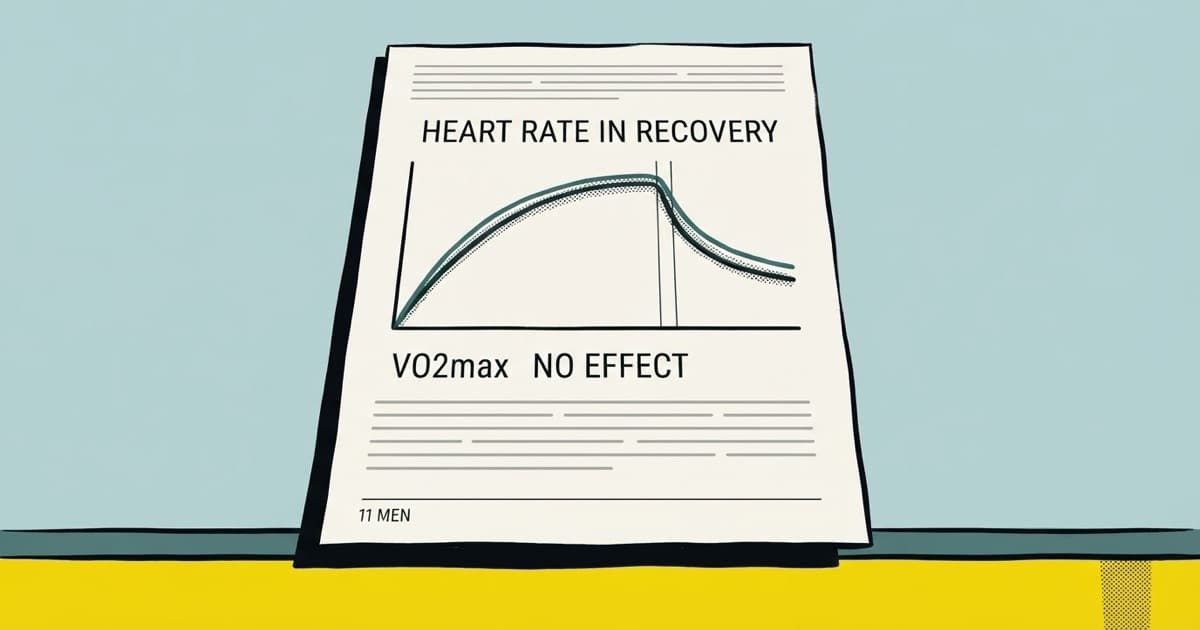
That caveat comes from a single study. Boone and Gilmore, 1995, eleven sedentary men — not athletes[2].
What it actually found:
- Maximal aerobic power, oxygen pulse and double product — unaffected.
- The only significant differences were in heart rate at 5 and 10 minutes of the recovery phase in the test run about two hours after intercourse.
- In the test performed later the same day, the differences were gone.
So where does the belief come from
Probably from two things at once. First, "the night before" cannot be separated from what people do around it: a later bedtime, alcohol, less sleep. Those are variables with well-documented effects on performance, and none of them is sex.
Second, pre-competition rituals work whether or not they have a mechanism. An athlete who believes abstinence strengthens him gets predictability and a sense of control, and those are worth more than most supplements.
There is no reason to take such a ritual away from anybody. There is a reason not to sell it as a research finding, because the research says something more modest: the day before makes no difference, and everything beyond that was measured on eleven men off the sofa.