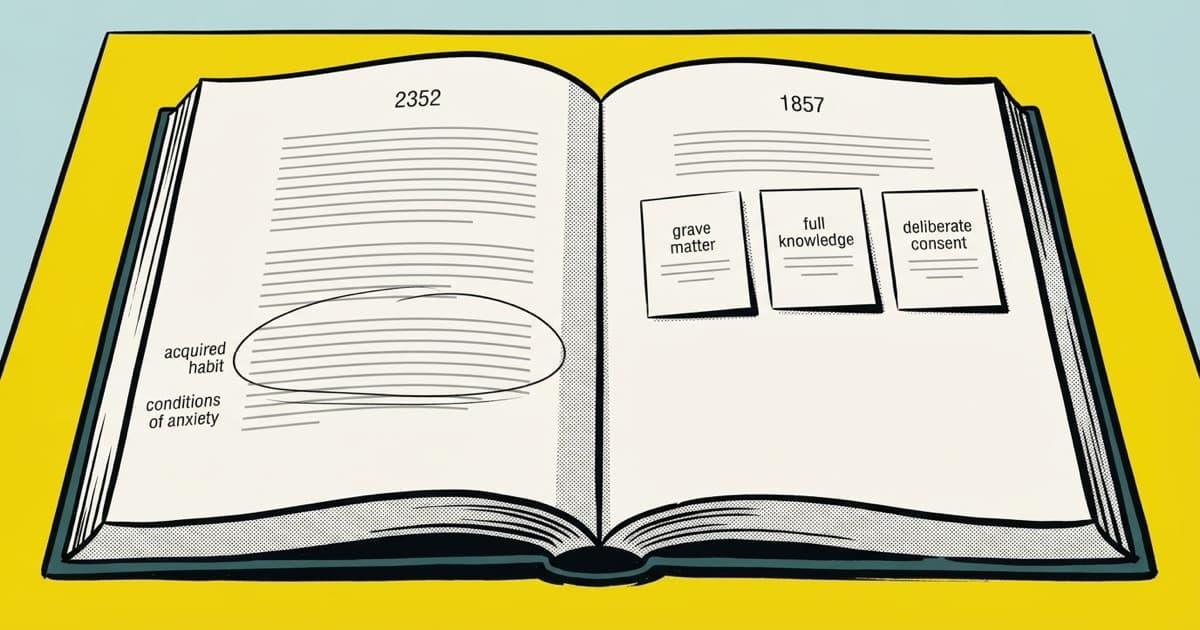
The Catechism gives this one paragraph — 2352 — and that paragraph has two halves. Almost every discussion quotes the first. The second changes the whole answer, and it is the one people are actually reaching for when they phrase the question differently: do I have to confess this, can I receive communion, when is it not a mortal sin.
This article does one thing: it gives both halves in full, adds the paragraph the Catechism applies to every sin, and sets out what the research says about guilt separately. It settles nobody's individual case, because it has neither the standing nor the information to do that.
What 2352 says, in full
The first half is the quoted one:
By masturbation is to be understood the deliberate stimulation of the genital organs in order to derive sexual pleasure. "Both the Magisterium of the Church, in the course of a constant tradition, and the moral sense of the faithful have been in no doubt and have firmly maintained that masturbation is an intrinsically and gravely disordered action."[3]
The second half sits directly beneath it, inside the same paragraph:
To form an equitable judgment about the subjects' moral responsibility and to guide pastoral action, one must take into account the affective immaturity, force of acquired habit, conditions of anxiety, or other psychological or social factors that lessen or even extenuate moral culpability.[3]
This is not a footnote and not a later softening. It is the second half of the same paragraph, and the Polish edition carries it identically — zmniejszają, a nawet redukują do minimum winę moralną[1].
Notice what it names: acquired habit and conditions of anxiety. If you are reading this at eleven at night after a week where you tried and it did not work, that sentence is not describing somebody else.
"Mortal or venial" — the answer is a condition, not a label
This question almost always gets answered as a verdict. The Catechism does not issue one. It states a condition, the same for every sin:
For a sin to be mortal, three conditions must together be met: "Mortal sin is sin whose object is grave matter and which is also committed with full knowledge and deliberate consent."[3]
All three at once. Grave matter, full knowledge, deliberate consent. Paragraph 1859 specifies that the consent must be "sufficiently deliberate to be a personal choice", and 1860 adds that "the promptings of feelings and passions", external pressures and pathological disorders also diminish the voluntary character of an act[2].
More generally, paragraph 1735 says imputability and responsibility "can be diminished or even nullified by ignorance, inadvertence, duress, fear, habit, inordinate attachments, and other psychological or social factors"[2].
Put those together. The document you are appealing to judges the act severely — and the same document, in the same place, requires that judging a particular person take habit and anxiety into account. Quoting only the first sentence is not a summary of the Catechism. It is half of it.
What this site will not tell you
We will not tell you whether the three conditions in 1857 are met in your case. That is not modesty and not a dodge: it is a question about your knowledge and your consent in specific moments, and a website cannot establish either. If you want that settled, the address is a confessor, or whoever you actually talk to about faith — not a site and not a forum.
That limit is the most important sentence here, so it is in the text rather than in a disclaimer at the bottom.
What the research says separately — and why it takes nothing from you
There is a second side to this that is rarely mentioned in this context and that people often find to be a relief.
Guilt can run strong enough that it starts to look like addiction. The ICD-11 guidelines anticipated exactly that case and rule it out explicitly: distress "entirely related to moral judgements and disapproval about sexual impulses, urges or behaviours is not sufficient" to meet the requirement for compulsive sexual behaviour disorder[4].
The analysis of the phenomenon goes further. Feelings of addiction to pornography "may be, in many cases, better construed as functions of discrepancies — moral incongruence — between pornography-related beliefs and pornography-related behaviors"[5].
Read that carefully, because it is easy to read as dismissal. It does not mean your reason is not real. If you want to cut this back because your faith asks it of you, that is a sufficient reason and nobody here is taking it from you. It means something narrower and practical: if the whole of the distress comes from the judgement rather than from losing control, then a day counter is answering a different question from the one you are asking.
Family, God, your own values — a reason that needs no defence
Most writing in this area assumes the only sensible reason to quit anything is health or performance. That assumption is simply narrow.
People cut things back because they hold themselves to commitments that do not show up in an outcome measure: because they want to be someone for their family, because their faith asks something of them, because they do not want their evenings decided by something they never chose. Those are sufficient reasons and they do not need a clinical trial underneath them.
This site takes one position on them: it does not grade them and does not try to replace them with reasons of its own. It also will not tell you who you are — not that you are failing, and not that you are strong. It does something smaller and checkable: it helps you write down how it went and show that to two people you already know.
What to do about it
If, having read the above, you want to cut this back — for any reason — then three things can be said about method, each with a number attached to it and none of them amounting to "try harder". They are set out separately in the article on how to stop.
The short form: decide before the moment arrives, and make the plan an action rather than a prohibition. Record daily how it went. Tell two people you already know — not a forum.
And if the pattern persists, returns despite real attempts, and genuinely gets in the way of your life, that is the line past which those three things are too small. The address then is a professional rather than a counter, and we have collected where to look.