Start with a sentence you will not find in any of the first ten results for this question: there is no study on quitting masturbation. Nobody has run a randomised trial where one group gets a method, another does not, and the two are compared six months later. Anyone promising you "five proven techniques" is working from personal experience or from nothing.
What does exist is more general and therefore less exciting: decades of research on how repeated behaviour changes at all. That literature says three specific things. None of them is "try harder".
1. Make the decision before the moment arrives
An intention like "I'm stopping tomorrow" is a wish about a goal. It has one flaw: when the situation that requires acting on it turns up, the decision is still to be made — and it gets made at the worst possible moment, at eleven at night, tired, with the phone already in your hand.
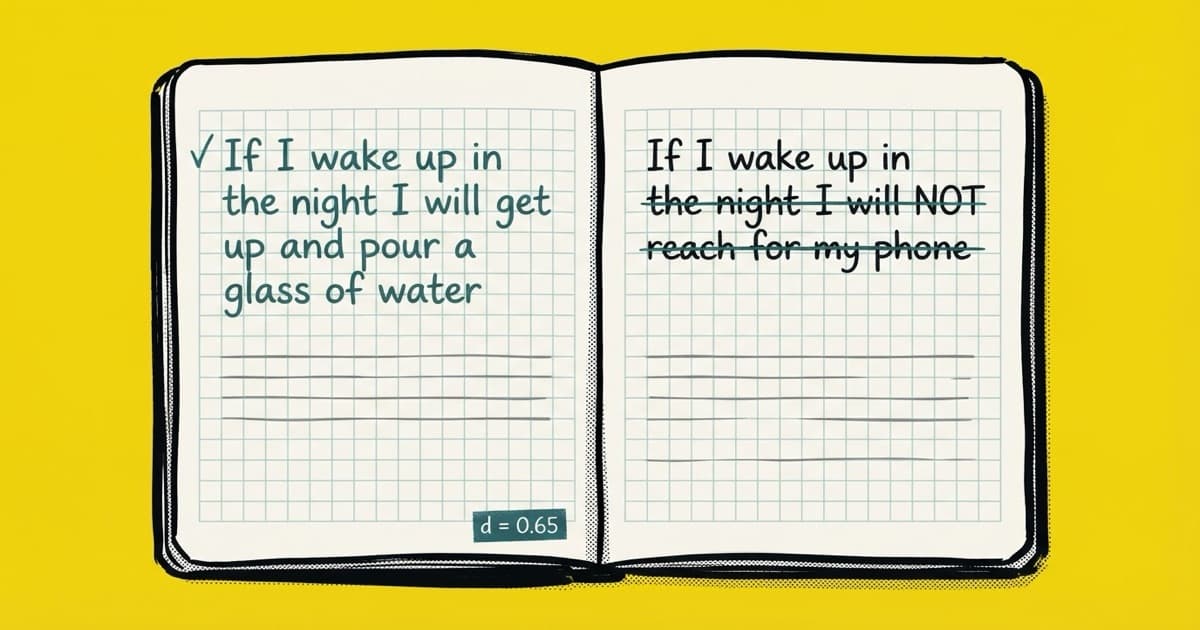
The alternative is called an implementation intention and looks like this: "if X happens, I will do Y". A meta-analysis of 94 independent tests found that recasting an intention in that form produces a medium-to-large effect on goal attainment, d = 0.65[1]. The mechanism is not that you want it more. It is that the situation is already assigned to a response before it shows up.
One detail decides whether the plan works: Y has to be an action, not a prohibition. "If I wake up in the night, I will NOT reach for my phone" contains exactly the image it was meant to exclude. "If I wake up in the night, I will get up and pour a glass of water" does not. That is not word games — it is the difference between a plan that reinforces the association and one that substitutes a different one.
2. Record how it went — ideally where somebody can see it
The second finding was established across 138 studies and 19,951 people. Simply monitoring progress towards a goal raises attainment: d+ = 0.40, 95% confidence interval [0.32, 0.48][2]. That is a modest effect obtained with no therapy at all, from the act of noting things down.
The same analysis checked what makes it larger. The effect was greater when the outcome was reported to somebody or made public, and greater when the information was physically recorded[2] rather than merely thought about. That is where the whole business of tapping a day and drawing a grid of squares comes from instead of a list of dates: a record you can take in at a glance is the recorded thing this analysis is talking about.
3. Have people you already know alongside you
Here the finding is the most specific of the three and the most inconvenient for app builders. A meta-analysis of digital peer support covered 73 studies; the overall effect on mental health was SMD 0.53. Broken down by the source of the support: informal, naturally occurring support — SMD 0.74. Formal support, from trained people, paid or unpaid — SMD 0.37[3].
A friend you already know works twice as well as a moderator.
The usage data points the same way. An analysis of real-world engagement with 93 mental-health apps found a median 30-day retention of 3.3% — of a hundred installs, three come back after a month. Peer-support apps had a median of 8.9%[4]. The honest caveat nobody usually adds: that category contained only two apps, so it is not a strong statistical basis. The direction agrees with the meta-analyses, which are large — but this particular number is weak and should be quoted as weak.
What no app has demonstrated, this one included
A 2025 review took 23 apps for problematic pornography use and scored them with the Mobile App Rating Scale. The dominant features were counting days abstinent, goal setting and psychoeducation. And the result that ought to end every argument about "which app is best": none of them referenced literature providing evidence of its own effectiveness[5].
This service does not reference any either, because there is nothing to reference. It can do the three things above — a plan written in advance, a daily record, two people who can see it — and nothing more. Any sentence beyond that would be selling.
When this stops being a question of habit
There is a line beyond which those three things are not enough, and it is worth knowing. ICD-11 describes compulsive sexual behaviour disorder as a persistent pattern of failure to control intense sexual impulses "over an extended period (six months or more)", causing marked distress or impairment in functioning[7].
And the caveat that matters most in this subject: the classification explicitly excludes the case where the distress comes entirely from moral judgements about one's own behaviour[7]. The analysis of that phenomenon puts it more strongly still — feelings of addiction to pornography may in many cases be better understood as a discrepancy between beliefs and behaviour rather than as an addiction[6].
That distinction does not invalidate anybody's reason. If you want to cut this back because of your own convictions, that is a sufficient reason and nobody here will take it off you. The point is different: knowing what you are up against changes where to look for help. If it persists and genuinely gets in the way, the right address is a clinician rather than a day counter.
The short version
- Write the sentence "if this specific situation, then this specific action". Not a prohibition.
- Note down each day how it went. Record it, do not just reflect on it.
- Tell two people you already know — not a forum.
Three things, each with a number in a meta-analysis, none of them a promise. If you are looking for a fourth, you are probably looking for something nobody has studied.