Start with the number that explains why almost nothing in this category works.
An analysis of real-world usage across 93 mental health apps found a median 30-day retention of 3.3% and a median daily open rate of 4.0%[2]. Of a hundred people who install such an app, three or four come back after a month. This is not a matter of poor execution — it is the level of the whole category.
One group breaks out of it clearly: peer support, with a median retention of 8.9% and daily opens of 17.0% — close to three times the median[2]. The honest caveat: that category contained only two apps, so it is not a strong statistical base. But the direction matches the meta-analyses, and those are large.
Five rules follow, each with a specific finding behind it.
1. Invite people you actually know
A meta-analysis of digital peer support (73 mental-health studies, overall SMD 0.53) split the result by the source of support. Informal, naturally occurring support gave SMD 0.74. Formal support — from trained people, paid or unpaid — gave 0.37[1].
A colleague works twice as well as a moderator. It is the one finding in this whole project that is both strong and completely free to implement.
2. A board, not a thread
The same meta-analysis compared formats: apps and video conferencing produced moderate effects, while forums and discussion boards produced small ones, SMD 0.21[1].
A place where you can see at a glance who checked in today beats a place where you have to read forty comments to work it out.
3. The challenge has to end
The same paper contains a moderator that surprises people: greater dosage of intervention was associated with lower effectiveness[1].
An open-ended challenge sounds more ambitious, but it is a challenge that cannot be won. An end date turns it into something with a conclusion and a summary — and it can then be repeated, without the sense that the last one failed.
4. The check-in has to be visible
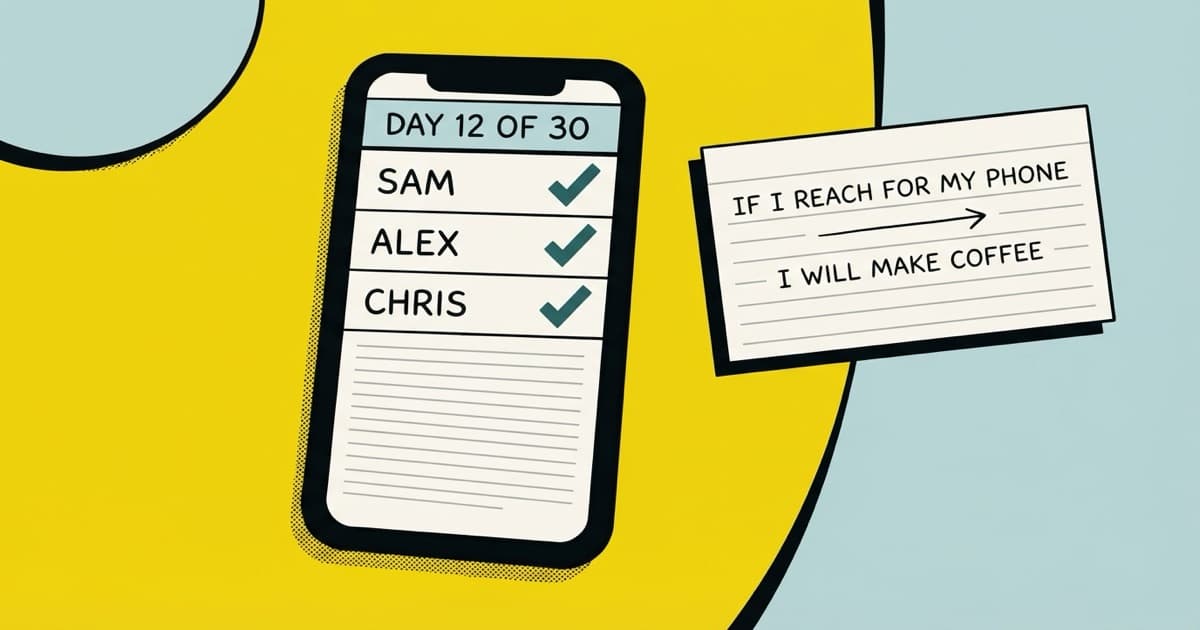
A meta-analysis of 138 studies (19,951 people) found that interventions increasing the frequency of progress monitoring improve goal attainment: d = 0.40 (95% CI 0.32–0.48)[3]. And this is the part that is a design instruction: the effect was larger when outcomes were reported or made public, and when the information was physically recorded.
So: a daily check-in, visible to the group, kept in a history. Not because it looks better that way, but because that is what the moderator says.
5. Everyone writes three if-then plans
A meta-analysis of 94 independent tests: framing a plan as "if [situation], then [action]" improves goal attainment with d = 0.65[4]. It is the strongest single effect in this whole set.
With one hard condition: the plan must name a replacement action, not a prohibition. "If I wake up and reach for my phone, I will get up and make coffee" — never "then I will not open the browser". A prohibition plan summons the cue and strengthens the association it was meant to break. In this app the prohibition form is rejected by validation, in the database, and that is not excessive.
And the stake?
Deposits work — for those who accept them. In a trial of 2538 people, reward programmes were accepted by 90.0% and deposit programmes by 13.7%[5]. Among those who did accept a deposit, effectiveness was markedly higher (52.3% versus 17.1% abstinent at six months), but that comparison now concerns only people who volunteered for it.
The design conclusion: a stake must be optional and off by default, because roughly one in seven will take it. The same trial compared group with individual commitment: 51.9% versus 50.6%, p = 0.55 — no difference. The group does not work through the stake. It works through what points 1 to 4 describe.
Which is why a stake in this app is a declaration between people, non-monetary by default, about which the service knows nothing beyond the fact that somebody typed it.