The first page of results for this question is built around one word: addiction. Treatment centres, counselling services, a subreddit, videos. So start with the thing none of those results says up front.
"Porn addiction" is not a diagnosis. It is not in ICD-11 and it is not in DSM-5 — neither of the two classifications medicine actually uses.
That does not mean you do not have a problem. It means the name you are searching under leads you to material that has nothing underneath it. Here is what does.
What exists instead
ICD-11 has compulsive sexual behaviour disorder, code 6C72. It describes a persistent pattern of failure to control intense, repetitive sexual impulses "over an extended period (six months or more)", causing marked distress or impairment of functioning[1].
Notice what is not in that description. No number of hours, no number of times a week, no list of content. Loss of control, and what it costs.
And one more sentence that saves people months of unnecessary worry here: distress arising entirely from moral judgements about one's own impulses is not sufficient for that diagnosis[1].
The analysis of the phenomenon goes further: feelings of addiction to pornography may in many cases be better understood as a discrepancy between beliefs and behaviour rather than as an addiction[6]. That does not invalidate your reason. It only changes where to look for help, if it turns out the problem is the judgement rather than the control.
How long does it take
There is no study on that. The figure of 90 days circulating everywhere comes from the community, not from the literature. Nobody has established a threshold past which it "works".
What has evidence behind it
There is no research on quitting pornography. There are several decades of research on how repeated behaviour changes at all, and it says three things.
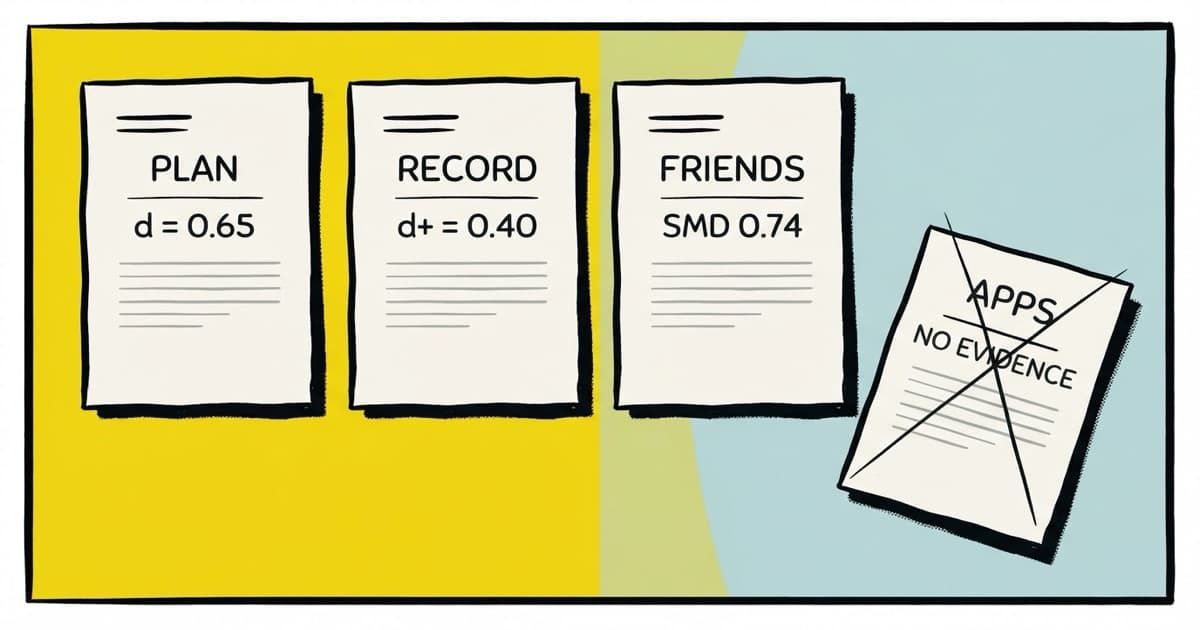
One: decide in advance, not in the moment. A meta-analysis of 94 independent tests found that turning an intention into the form "if situation X occurs, I will do Y" produces a medium-to-large effect, d = 0.65[2]. One detail decides everything: Y has to be an action, not a prohibition. "I will not pick up my phone" contains exactly the image it was meant to avoid. "I will get up and pour a glass of water" does not.
Two: write it down. An analysis of 138 studies and 19,951 people found that monitoring progress towards a goal raises attainment: d+ = 0.40, confidence interval 0.32–0.48[3]. The effect was larger when the result was reported to someone and when the information was physically recorded[3] rather than merely thought about.
Three: do not do it alone, and do not do it on a forum. A meta-analysis of digital peer support covered 73 studies. Informal support, from people already present in someone's life — SMD 0.74. Formal support, from trained supporters — SMD 0.37[4].
A friend does twice as well as a moderator.
What no app has proven, including this one
A 2025 review took 23 apps for problematic pornography use and rated them with the Mobile App Rating Scale. Day counting, goal setting and psychoeducation dominated. And the finding that should end every argument about which app is best: none of them referenced literature providing direct evidence of its own efficacy[5].
This one does not either, because there is nothing to reference. It does the three things above and nothing more.
The short version
- Write one sentence: "if a specific situation, then a specific action". Not a prohibition.
- Record daily how it went. Write it, do not just think about it.
- Tell two people you already know. Not a forum.
And if this has gone on for months, comes back despite real attempts, and genuinely gets in the way of your life — that is the line past which those three things are too small. The address then is a professional, and we have collected where to look.