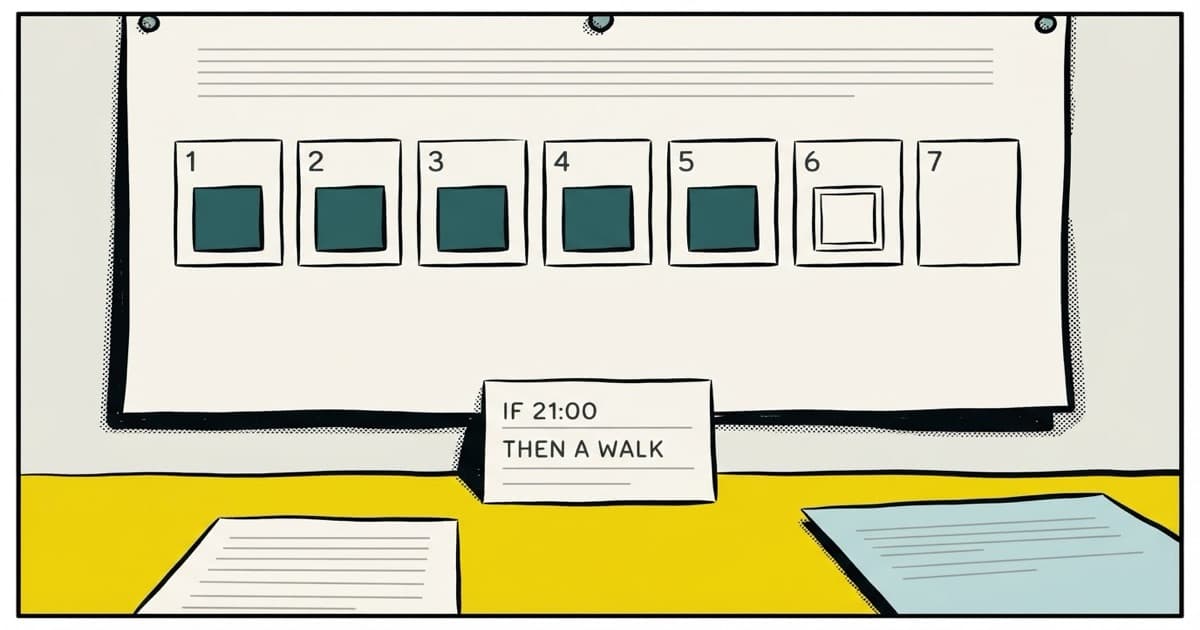
The rules below are not the ones circulating under this name. There is no dark room, no fasting, no silence. They are the rules of stimulus control, the behavioural technique the term was coined for before it became a stunt [1], written as a seven-day plan with one addition: a small group of people you already know who see whether you kept to it.
Five rules
1. One behaviour, named precisely. Not "dopamine", not "my phone". The behaviour is a thing you do, with a time and a place: "opening short-video apps after 21:00", "porn when I am alone in the flat in the evening", "checking notifications before getting out of bed". If you cannot name it, you cannot remove its cue.
2. Remove the cue, not the reward. Dopamine neurons respond to the prediction of reward more than to the reward itself: they fire for a cue that promises something better than expected and fall silent once the reward is fully predicted[2]. The practical reading is that the notification, the app icon, the bookmark and the empty flat at 22:00 are the problem, not the pleasure at the end. Log out, delete the app for the week, move the charger out of the bedroom, make the evening belong to something else.
3. A replacement, written as if-then. "If it is 21:00 and I reach for the phone, then I put on shoes and walk round the block." A plan that names what you will not do reinforces the cue-response link; a plan that names what you will do instead gives the cue a new ending. Every plan in this product's onboarding is checked for exactly that, because it is the part with the strongest evidence behind it.
4. Keep every healthy thing. Food, exercise, music, sunlight, other people. The extreme versions of the detox strip these out and, as Harvard Health's Peter Grinspoon wrote, their practitioners end up "depriving themselves of healthy things, for no reason, based on faulty science"[1]. The healthy things are the replacement.
5. Somebody sees the result. Not a public forum. Two or three people who know you, who see one bit per day — kept or not — and nothing else. That is the mechanic this site is built around, and the reason the challenge is closed.
The seven days
| Day | What happens | What you do |
|---|---|---|
| 1 | The cue is gone and the urge arrives on schedule, strong, around the usual time. | Run the if-then plan once. Note the time of the urge; that is your cue window. |
| 2 | Urges at the same time, slightly shorter. Boredom in the gap. | Fill the cue window in advance: the walk, the call, the book, booked like an appointment. |
| 3 | The hardest day for most people: novelty of the plan has worn off, habit has not. | Tell the group before the cue window, not after. Being seen before the urge is worth more than reporting after it. |
| 4 | Urges shorter and later. Sleep often improves if the behaviour was an evening one. | Add one healthy thing you had been skipping. Keep the replacement. |
| 5 | A quiet day, or a surprise urge from an unusual cue (stress, a message). | Name the new cue. Write a second if-then for it. |
| 6 | Confidence, and with it the temptation to "test" the old behaviour. | Do not test. The point of the week is to learn the cue map, not to prove resistance. |
| 7 | The week is complete. | Decide, in writing, which cue changes stay permanently (usually: the charger out of the bedroom, the app off the phone) and which were temporary. |
Why the if-then plan is the part that carries the week
The if-then format is not a stylistic choice. A meta-analysis of 94 independent tests found that forming an implementation intention — a plan of the form "if situation X, then I do Y" — had a medium-to-large effect on goal attainment, d = 0.65, across a wide range of goals[3]. That is a larger and better-replicated effect than anything claimed for dopamine itself. Two things follow for a detox. The seven days are a cue-mapping exercise whose output is a set of plans, not a finish line. And a plan that names a replacement survives a missed day, because the cue still has somewhere to go.
What this plan does not do
It does not lower dopamine, reset tolerance or make ordinary pleasures feel more intense; there is no mechanism for any of that[1]. It does not treat compulsive sexual behaviour disorder, depression or ADHD; if the behaviour has been running your life for months, read where to find help first. And it does not require buying anything, although if you want to read further, the books worth reading says which ones argue what. The background to the term itself is in What is a dopamine detox?.