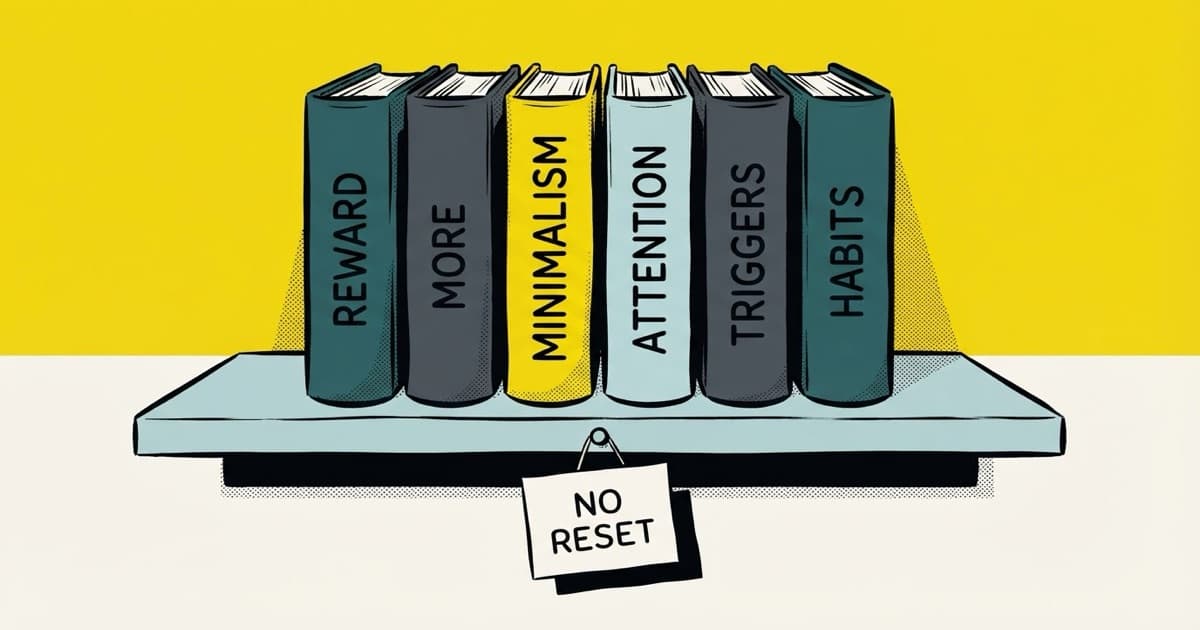
The shelf labelled "dopamine detox" holds two kinds of book: ones that explain what dopamine does and why constant reward wears people down, and ones that tell you what to do about your phone. Almost none of them are about detoxing dopamine, because that is not a thing[1]. Here is what each of the ones worth reading actually argues, in the publishers' own framing, and who each is for.
Books about the mechanism
Dopamine Nation: Finding Balance in the Age of Indulgence — Anna Lembke, MD (Dutton, 2021)[3]. A Stanford psychiatrist on the balance between pleasure and pain, and on why easy access to high-reward stimuli — the publisher's list runs from drugs and food to gambling, shopping, gaming and social media — pushes people into compulsive overconsumption. The chapters are built on patients' stories. Read it if you want the clinical view of why a feed, a game or porn behaves like a substance, and the recovery-based toolkit that follows. Do not expect a protocol; expect an argument.
The Molecule of More — Daniel Z. Lieberman, MD and Michael E. Long (BenBella Books)[4]. The publisher's one-line summary is the book's whole thesis: "From dopamine's point of view, it's not the having that matters. It's getting something — anything — that's new." It is the readable version of the reward-prediction-error research[2]: why anticipation outruns possession, and why novelty is the lever. Read it to understand why the cue, not the reward, is what a detox has to remove.
Books about attention and the phone
Digital Minimalism: Choosing a Focused Life in a Noisy World — Cal Newport (Portfolio, 2019)[5]. The one with a protocol: a thirty-day "digital declutter", after which you reintroduce only the tools that serve something you value. Newport is a computer scientist, and the argument is about technology serving your goals rather than dominating them. Read it if your problem is the phone in general rather than one behaviour in particular; the thirty days map neatly onto the stimulus-control rules in the 7-day plan, stretched.
Stolen Focus: Why You Can't Pay Attention — Johann Hari (Crown; paperback 2023)[6]. The counterweight. Hari's argument is that the willpower explanation is incomplete: external forces, and companies that profit from captured attention, have taken focus, and he lists twelve causes from the decline of mind-wandering to pollution. He also reports trying the individual fixes, including three months without his phone, without lasting success. Read it if a detox has left you blaming yourself; it reframes the problem as partly structural, which is both fairer and more useful.
Indistractable: How to Control Your Attention and Choose Your Life — Nir Eyal[7]. Eyal's own description of the book's focus is to "identify and manage the psychological triggers that lead to distraction". The emphasis on internal triggers — the discomfort you are escaping when you reach for the phone — is the piece most detox advice misses. Read it after the mechanism books, when you want tactics.
The one about habits in general
Atomic Habits — James Clear[8]. Not about dopamine or screens, but the most-read book on changing a behaviour, and its line "You do not rise to the level of your goals. You fall to the level of your systems." is the detox argument in one sentence: the cue environment is the system. Read it if you want the general toolkit; the if-then plans this product is built on come from the same research tradition[9].
What is not on this list
Titles that sell a dopamine "fast" as a biological reset, and workbooks that turn a weekend of deprivation into a programme. The science they lean on is the misreading Harvard Health took apart in 2020[1], and the practice they describe strips out the healthy things that make the week bearable. If a book's method requires silence, hunger and no eye contact, the method is the problem.