This is the question most people in this neighbourhood are actually asking, and the one where the internet has the most certainty on the least evidence.
The defensible answer has two parts, and both have to be given together — separately, each is misleading.
Part one: watching itself
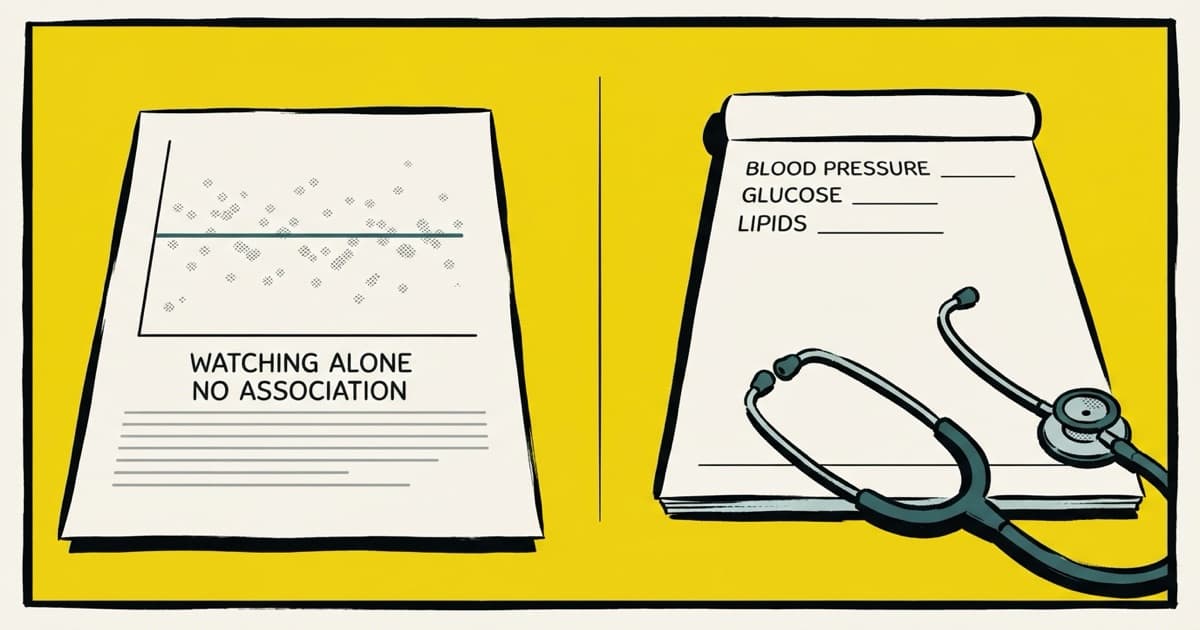
The strongest available study covered three samples: 147 undergraduates, 297 men matched to US representative norms, and a longitudinal sample measured four times over a year (from 433 people at the start to 196 at the end). The authors' conclusion, in their own words: "there is little or no evidence of an association between mere pornography use and ED"[1].
That matters, because it disposes of the most popular version of the claim — the one where the number of hours is what counts.
Part two: feeling out of control
Across those same three samples there was consistent evidence of an association between self-reported problematic use and erectile dysfunction — but measured cross-sectionally, meaning at the same moment[1].
And here is the sentence that gets lost online: in the latent growth curve analyses, the part of the study that looks at change over time, there were no significant relationships between any pornography-related variable and the trajectory of erectile dysfunction. The authors summarise this as no evidence of a causal link.
What the newer review says
A 2025 systematic review of 11 studies from 2013–2023 describes the literature as conflicting: some studies find associations, some find none, some find benefits. The finding that recurs most often is that frequency is not the predictor — a problematic pattern of use is; separately, a preference for pornography combined with masturbation was associated with erectile dysfunction[2].
What to do in practice
One thing matters more than the entire discussion above.
Erectile difficulties can be an early sign of cardiovascular disease and diabetes. The arteries in the penis are narrower than the coronary ones, so a vascular problem can surface there years earlier. Three months of "resetting" instead of an appointment is three months in which nobody checked blood pressure, glucose or lipids.
If the difficulty is new, persistent, or shows up without a screen involved, it is a matter for a doctor, not for a challenge. Cutting back on pornography may be a sensible idea for entirely different reasons, but it is not a diagnostic test and does not substitute for one.