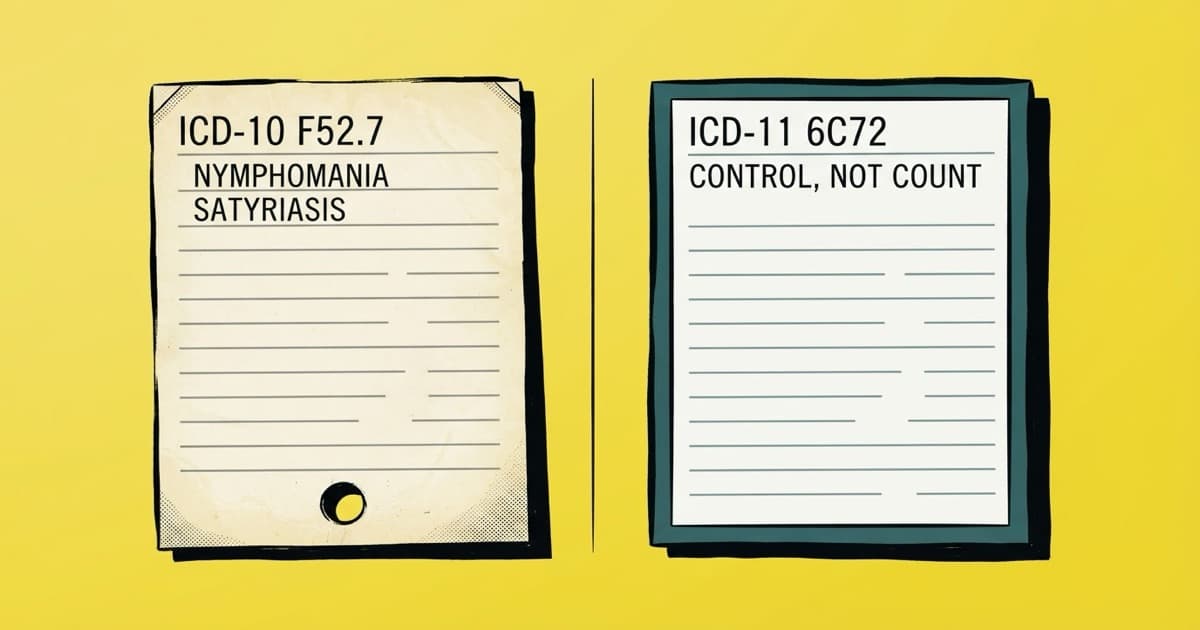
Both words sound archaic now, and both were classification terms until recently. It is worth knowing how they disappeared, because it is one of the few stories in psychiatry where you can watch a change of definition change who gets treated.
Where they lived
ICD-10 carried the code F52.7, "excessive sexual drive", and nymphomania and satyriasis appeared as inclusion terms under it[1]. Satyriasis described men, nymphomania women. The same thing, two names, one drawer.
Notice what is in the name of the category: "excessive drive". The criterion is quantitative. Whoever decided how much is too much decided the diagnosis.
Why it could not stay
The "excessive drive" construction has a flaw that is obvious the moment you look at it: there is no threshold anyone can defend. There is no number of encounters per week above which illness begins. What counted as excess always came from the norms of the period — and in the case of nymphomania, from norms about women, written by men, without data.
ICD-11 contains neither nymphomania nor satyriasis. In their place sits compulsive sexual behaviour disorder, code 6C72[3], built on an entirely different idea.
What changed in the definition
The new criterion does not ask "how much". It asks about the failure to control intense, repetitive sexual impulses, persisting for six months or more, and whether it causes marked distress or impairment of functioning[2].
And it adds a clause the old category did not have and could not have had: distress entirely related to moral judgements and disapproval about one's own urges is not sufficient for the diagnosis[2].
Why this is practical
Because the words are still used in conversation and in search boxes. Somebody looking up "nymphomania" is most likely looking for an answer to whether there is something wrong with their sex drive.
The modern classification's answer is: intensity alone is not a disorder and never was — it was one only briefly, in a category that was withdrawn for exactly that reason.